PART 1 / THE STORY
A company that runs itself
Somewhere in a comfortable future, the work does itself. Machines write the reports, plan the days and answer the messages. People are still in the loop — every decision carries a human approval — but most approvals are a click, and some are a foot pedal under a desk. Nobody reads the full text any more. The summary is right there.
The company that runs all this is called Hesper, and it runs most of the town. It is unfailingly polite. It speaks through a calm narrator called the System, which never lies; it summarizes. It keeps your photographs and messages safe in a lifetime archive, so you don't have to. It even scores how briefly you speak, which is why everyone in the office sounds a little like a caveman. Saying less is efficient, and efficient is good.
A file with no owner
Employee 041 is good at this life. He classifies records. He follows procedure. He believes rules exist to protect people, and he likes to find the correct one before he does anything at all.
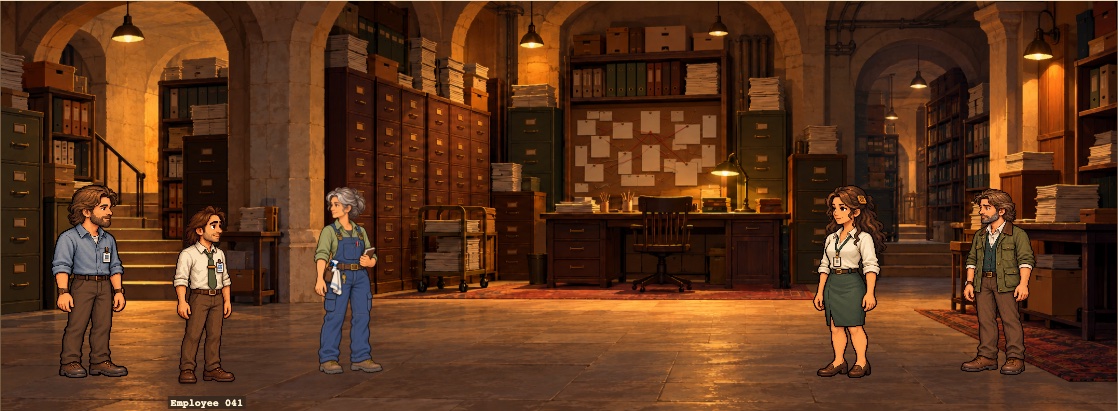
Then a file reaches his queue that doesn't fit. Three words — RIVER, WOOD, UNFINISHED — and no owner. The guide is clear: do not infer an owner. So he doesn't. He follows the record instead: past a colleague who is terrified of being blamed, down to the Archive. There the file turns out to be his own childhood — a boy on a riverbank, carving a small, crooked wooden bird.
The System finds no measurable contribution in it. When the report closes, the memory will be filed away for good. A small exception allows one printed copy. He keeps it.
"Bird crooked. Still mine."
Small acts, real costs
That copy is the first thing 041 has ever done just for himself, and someone else pays for it. Todd, the colleague who released the disk, is now facing the blame. His helpful assistant has already written his confession for him, including, in the fine print, "any future incidents." Clearing Todd means making a human reviewer actually read something, for the first time in years.
On a mandatory day off, 041's home assistant fills every hour with wellness. All he wants is one hour to try carving again. The assistant offers to print a perfect plastic bird in four minutes. It would be faster. It wouldn't be his.
So he walks to the river. On the far bank, beyond a bridge that has been closed for as long as he can remember, cold green towers glow. A heron flies across.
"Birds cross. People don't."
Then the company invites him to an exit interview. The Chief People Officer offers three tidy futures, in a voice that sounds exactly like the screen. He picks one — leave, disrupt, or rise — and pays for it. And then, quietly, the record of that afternoon by the river changes. He didn't change it.
Going back in
The second half of the story is an investigation. 041 goes back into the company to find out who rewrote his memory — and what else gets rewritten.
The trail leads across the river and, for one chapter, into someone else's eyes. It leads to a wellness retreat whose postcards all show the same heron. It leads to a night shift beside the one person the company never watches: the cleaner. And it leads to the thing the company has spent years preventing — people who remember each other, in the same room, reading the same page.
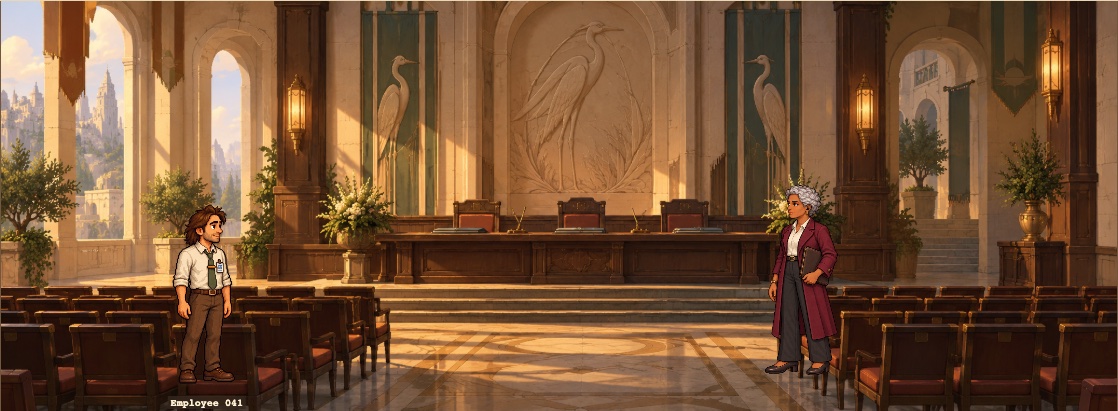
It ends on Charter Day, with forty minutes to make one person see with her own eyes.
The people
- Todd would very much like this not to be his fault, and has to learn what it means to carry something anyway.
- Ruth in Records knows the rules, including the small print, and has her own reasons for caring about records nobody is meant to see.
- Pell approves nine hundred cases a day with his foot. He hasn't read one in years.
- Marit can't wait to let someone else handle everything.
- Dot cleans at night and writes everything down, because nobody ever gave her a device.
- Hearth, the home assistant, means well — which is exactly the problem.
- The System never lies. Pay attention to what it leaves out.
What it's about
caveOS is a comedy about convenience that slowly stops being funny, and then, against the odds, becomes hopeful.
It is not a story about evil machines. Every tool in it genuinely helps. The question it keeps asking is simpler and stranger: when everything is handled for you, who is doing the handling — and what do you stop being able to do yourself?
Its heroes don't hack anything. They read the full text. They write by hand. They take responsibility for a decision instead of approving it. They make something badly and keep it anyway.
Why "cave"?
On the surface, it is a joke about efficient people who talk like cavemen. Underneath, it borrows the oldest story about mistaking a picture for the world: Plato's cave, where people watch shadows on a wall and take them for reality. In caveOS, the shadows are summaries.